Fleet.
Everyone is a manager.
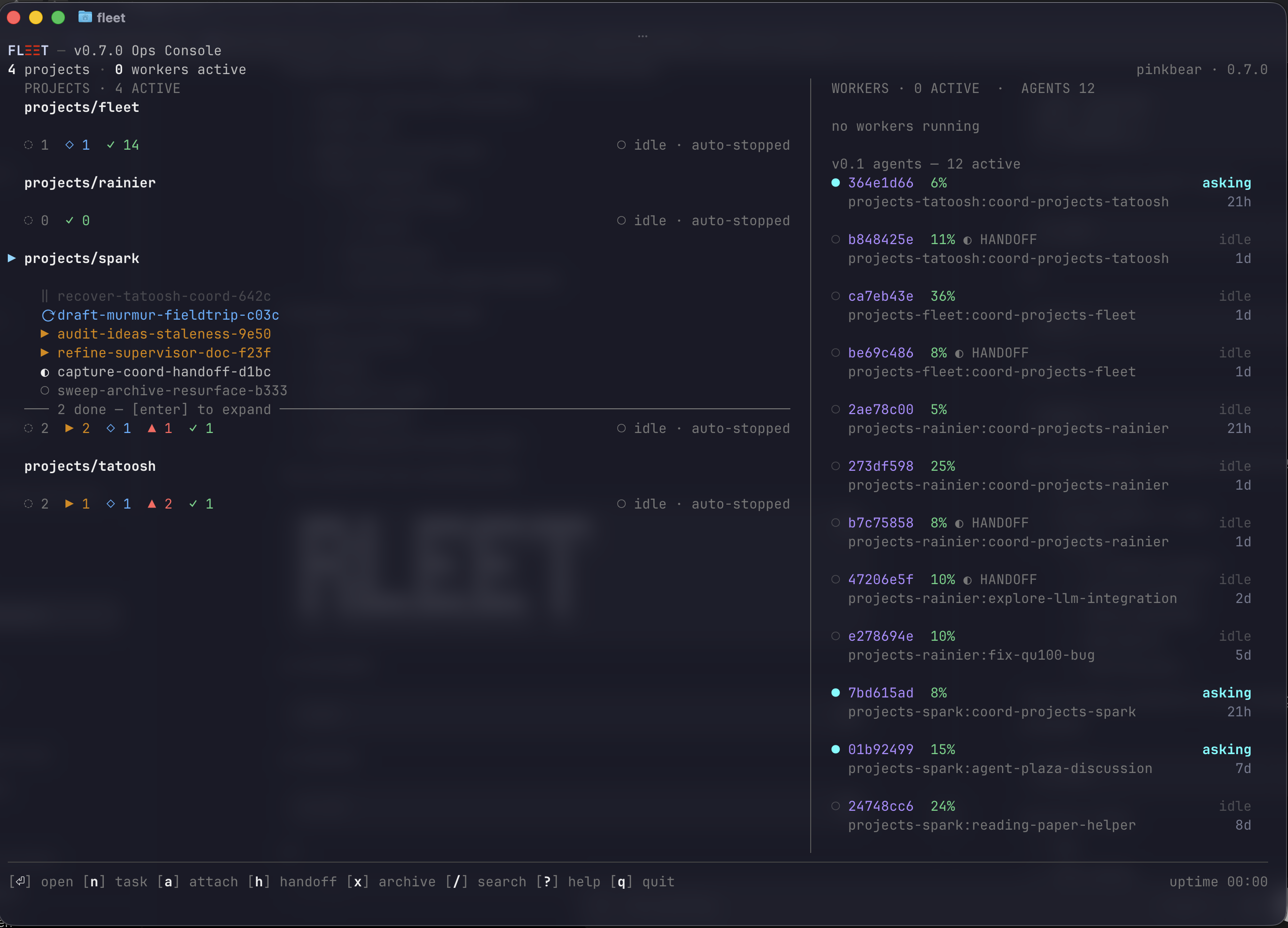
Running many Claude Code sessions across many repos turns you into a human scheduler: which tab is blocked, whose context is hot, which PR needs a rebase. Fleet collapses that surface into one TUI. A per-project coordinator owns the task list and dispatches workers; every worker runs in its own git worktree on its own branch; context handoffs happen automatically with the prior session's state attached. You stay the manager. The agents do the work.
Why Fleet
- 50% context handoff, with context.
fleet-guardwatches every agent's context usage and triggers a handoff at 50% / 70% thresholds. The successor receives a structured doc carrying prior state, decisions made, files modified, and next steps. - One coordinator per project. Each project gets a dedicated coord session that owns
tasks.md, dispatches workers, and shepherds PRs. Your single point of contact per repo. - Coord designs and splits the work. Describe a problem; the coord runs a planning conversation (scope, edge cases, testing plan), then splits it into tasks and dispatches workers — only after you approve. No surprise scope.
- Tasks run in parallel. Above parallelism 1, every worker runs in its own git worktree on its own branch. Multiple PRs open at once, all independently progressing.
- Workers learn as they work. Each project keeps a
learnings.mdlog that workers append to as they hit gotchas. The coord injects the top recent learnings into every subsequent dispatch — project intelligence compounds. - PR autopilot. Each worker watches its own PR. CI fails → retry-fix subagent. PR goes BEHIND or DIRTY → rebase subagent on an isolated worktree. Trivial review comments addressed inline; substantive conflicts raise to the operator.
- Remote control. Mobile claude.ai can pair with running coord and worker sessions via the bundled remote-control daemon. Shepherd work from your phone.
Install
brew install edisonshen/tap/fleet
fleet init
fleet init installs the bundled fleet-guard and
coordinator skills under ~/.claude/skills/ and seeds
~/.fleet/standards.md. Runtime deps: tmux and the
Claude Code CLI.
Quickstart
cd ~/projects/myrepo
fleet                                   # open the dashboard
From the dashboard: [+] to register the current repo,
[a] on the project row to spawn its coord, then describe a problem to
the coord in plain English. It walks you through DISCUSS → PLAN-DOC → SPLIT
→ TASK LIST → TASK-PLAN-DOC; once you approve, the worker / reviewer / finisher
flow starts on the next tick.
Architecture
A project is a repo Fleet has seen. A coordinator is
a per-project Claude Code session that owns tasks.md (one coord per project,
NB-flocked). A worker is a Claude Code agent in a detached tmux session
running one task in its own worktree. A handoff fires when an agent's
context % gets hot — fleet-guard writes a structured doc and a fresh agent
picks the work up.
More
Source, docs, and changelog on GitHub. MIT licensed.